You know the scene. The pan is hot, there’s a little oil in it, and you crack in an egg. Thirty seconds later you’re chiseling it off the surface with a spatula, wondering what you did wrong.
Here’s the good news: it might not be you. Nonstick pans don’t last forever, and they rarely announce when they’re finished. They just quietly get worse, and we adapt by adding more oil, scrubbing harder and blaming our technique.
In this guide, you’ll find a 60-second test you can do at your stove right now, seven clear signs that a pan has reached the end of its life, the habits that wear coatings out faster, and a simple way to decide whether to replace one pan or start fresh with a new set.
The 60-Second Pan Test (Do It Right Now)
Grab the pan you use most and run through this quick check:
- Touch it. Wash and dry the cooking surface, then run your hand across it. It should feel smooth and even. Rough patches, bumps or sticky spots are a bad sign.
- Look at it under bright light. Tilt the pan and check for scratches, dull patches, peeling or flaking.
- Put it on a flat counter. Press gently on the rim. If it rocks or spins, the base is no longer flat.
- Wiggle the handle. It should feel firm and secure, with no play or creaking.
- Do the egg test. Heat the pan gently, add a small amount of oil and cook one egg. If it slides around easily, your pan is still doing its job. If it grips and tears, keep reading.
If your pan passed every step, great. If it failed even one, the next section will tell you what it means.
7 Signs Your Nonstick Pan Has Reached the End
1. Food sticks even with oil
This is the classic sign. A healthy nonstick surface lets food release with little fat. When eggs, pancakes and fish start clinging no matter what you do, the surface has worn down and no longer works as designed. Adding more oil won’t bring it back; it will only hide the problem for a while.
2. Scratches or flaking on the surface
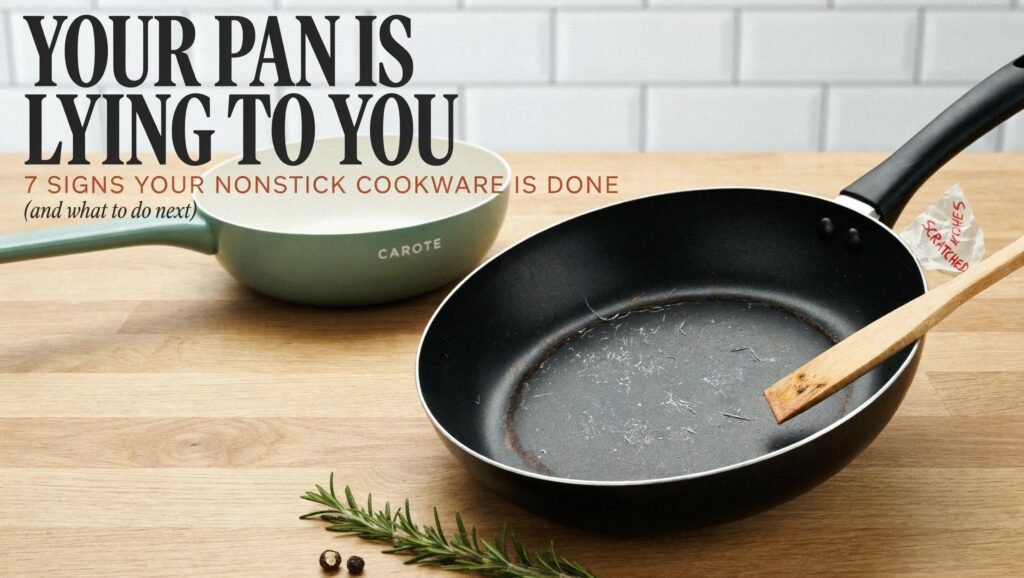
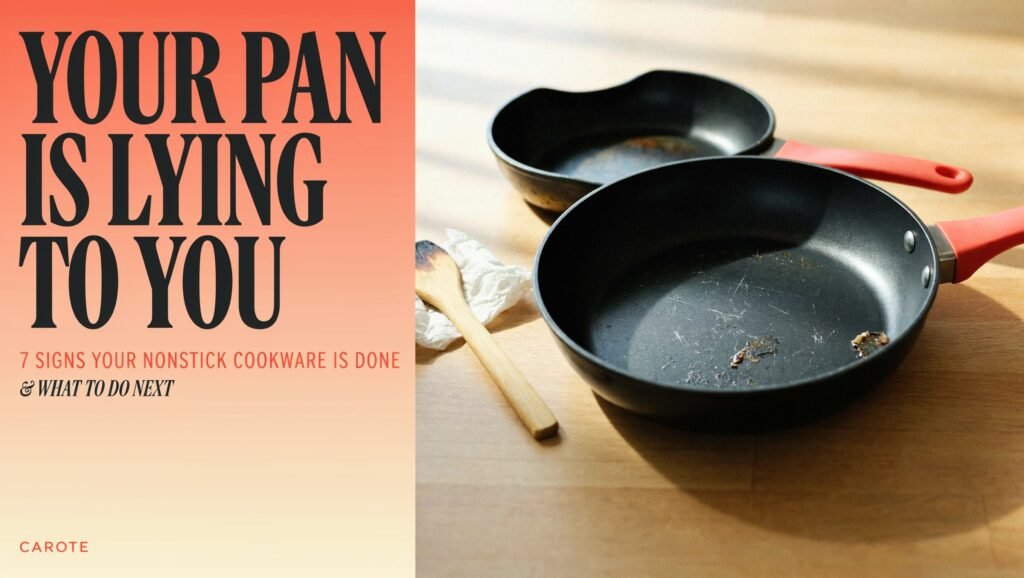
Fine surface marks happen to every pan over time. But deep scratches, bare patches or any coating that is peeling or flaking mean the pan has done its time. Stop using it at that point, because you don’t want pieces of coating ending up in your food.
3. The base is warped and spins on the burner
Pans can warp after sudden temperature changes, such as plunging a hot pan under cold water. A warped base makes poor contact with the burner. That means uneven heat, slower cooking and, on induction cooktops, weaker performance. A pan that wobbles on a flat surface won’t fix itself.
4. Dark, sticky residue that won’t wash off
A brownish film that keeps coming back, even after proper washing, is usually built-up oil that has baked onto the surface. Sometimes a gentle, thorough clean helps. If the residue returns within a few uses, the coating underneath has likely worn and is trapping it.
5. Uneven heating: burnt center, raw edges
If the middle of your pan burns while the edges stay pale, heat is no longer spreading evenly. This is often linked to a warped base or a worn-out surface, and it makes consistent cooking nearly impossible.
6. A loose or wobbling handle
A wobbly handle isn’t just annoying. It’s a safety issue when you’re lifting a pan full of hot food. Tightening the screw can sometimes help. If the handle keeps loosening, or the fixing point is damaged, it’s time to move on.
7. Discoloration that keeps coming back
Some light color change is normal with use. But if the surface darkens, turns patchy or looks stained in a way no cleaning fixes, it’s usually a sign that the coating has aged.
How many signs did your pan show? One sign may just call for better care. Two or more usually means replacement is the smarter move.
Is It Your Pan or Your Habits? 6 Mistakes That Wear Out Nonstick Coatings
Before you blame the pan completely, check whether any of these habits are shortening its life:
- Cooking on maximum heat. Nonstick surfaces do best on low to medium heat. Very high heat is hard on the coating and rarely necessary.
- Using metal utensils. Metal spatulas and whisks scratch the surface. Choose wood, silicone or nylon tools instead.
- Scrubbing with rough sponges. Steel wool and abrasive pads can strip a coating quickly. A soft sponge and warm soapy water are all you need.
- Shocking a hot pan with cold water. Sudden temperature changes are a common cause of warping. Let the pan cool first.
- Stacking pans without protection. Pans rubbing against each other in a cabinet get scratched. Use felt or cloth separators, or choose cookware designed to stack neatly.
- Overusing cooking spray. Aerosol sprays can leave a sticky buildup that is hard to remove and can make a pan feel like it’s failing.
Some Carote sets come with pan protectors and kitchen utensils, which makes it easier to build good habits from the very first day. Check the product page for exactly what’s included in each set.
Repair, Replace or Upgrade? A Simple Decision Guide
Not sure what to do next? Use this quick guide:
- Only a light, greasy film and no scratches? Wash thoroughly with warm water and a soft sponge. You may be able to get more life out of the pan.
- Food sticks and the surface is scratched, but the base is flat? Replace that single pan, especially if it’s your daily workhorse.
- Several pans show wear, or your collection is a mismatched mix of old pieces? A new set is usually better value than replacing pans one by one.
- Coating is flaking, the base is warped, or the handle is unstable? Retire the pan now.
Replace One Pan or the Whole Set?
There’s no single right answer, but here’s how to think about it.
Replace one pan if the rest of your cookware is in good shape and the problem is limited to your most-used frying pan. It’s the cheapest fix, and it works well when you simply need something that releases food properly again.
Replace the whole set if most of your pieces are showing their age. A matching set also gives you the right size for each job, with lids that fit and pieces that work together on your stove.
If you’re leaning toward a full refresh, these Carote sets are a good place to start:
- Carote Nonstick Granite Cookware Set, 8 Pcs is a compact set for couples or smaller households who want the essentials.
- Carote Nonstick Granite Cookware Set, 10 Pcs is a well-rounded option for families. It includes 9.5 and 11 inch frying pans, a 3.7 QT saute pan with lid, a 1.5 QT saucepan with lid, and 2.3 QT and 4.3 QT casseroles with lids.
- Carote Nonstick Pots and Pans Set, 13 Pcs, compatible with all stoves suits households that want more variety and need cookware that works across stove types.
Carote’s granite nonstick coating is designed for easy food release and easy cleanup, and many sets are described as PFOS and PFOA free. Always check the product page for the full specifications of the set you choose.
Short on Space? Upgrade the Way You Store Your Cookware
Here’s something many people overlook: the way you store your pans affects how long they last. Pans piled on top of each other, with handles sticking out in every direction, get scratched, dented and knocked around.
That’s where detachable handle cookware comes in. Take off the handle and the pans nest together neatly, using a fraction of the cabinet space. It’s a smart fit for small kitchens, rentals and anyone tired of the daily pan avalanche.
- Carote Detachable Handle Cookware Set, 6 Pcs is a compact, stackable set that’s great for small spaces.
- Carote 15 Pcs Nonstick Cookware Set with Removable Handles is a larger set that keeps the space-saving benefit while offering plenty of range for family cooking.
Many detachable handle sets are listed as oven safe and induction compatible. Check the details on each product page before you buy, especially for oven temperature limits and dishwasher use.
Cooking on the Go? Cookware for RVs, Dorms and Camp Kitchens
Small and temporary kitchens are tough on cookware. Space is limited, storage is rough and every piece has to earn its place.
For these setups, look at the Carote 7-Piece Nonstick Cookware Set with Stay-Cool Handles. It has been positioned for RV and camping use, and it’s a practical option for dorm rooms, first apartments and holiday cabins too.
How to Make Your Next Pan Last Longer
A new pan is a fresh start. A few simple habits will help you keep it that way:
- Wash it before first use. A quick wash with mild soap removes any factory residue.
- Preheat gently. Start on low to medium heat and let the pan warm up gradually.
- Use soft tools. Wood, silicone and nylon are your friends.
- Let it cool before washing. This protects both the coating and the base.
- Store it with care. Use pan protectors, felt separators or detachable handles to keep surfaces from scratching each other.
Even if a set is labeled dishwasher safe, hand washing is gentler on any nonstick coating and helps it last longer.
FAQ
How long should a nonstick pan last?
There’s no fixed number. Lifespan depends on how often you cook, how high you heat the pan, which utensils you use and how you clean and store it. With good care, a quality nonstick pan can serve you well for years. Heavy daily use and rough handling shorten that time.
Can I fix a scratched nonstick pan?
Unfortunately, no. Once the coating is damaged, there’s no reliable way to repair it at home. Replacing the pan is the safest option.
Is it okay to keep using a pan with minor scratches?
Very light surface marks may not affect everyday cooking. But if the coating is peeling, flaking or deeply scratched, stop using the pan.
Why does my new nonstick pan stick?
The usual causes are leftover residue from manufacturing, overheating, or oil buildup. Wash the pan before first use, cook on low to medium heat and avoid aerosol cooking sprays.
Can I put my nonstick pan in the dishwasher?
It depends on the product. Some Carote sets are listed as dishwasher safe, so check the specifications for your exact set. Washing by hand is still the gentler choice.
Ready for a Fresh Start?
A nonstick pan that sticks, scratches or wobbles isn’t a sign that you’ve lost your touch in the kitchen. It’s simply a pan that has done its job and is ready to retire.
Run the 60-second test, count the warning signs, and decide whether you need one new pan or a whole new set. Then give your next one the care it deserves.
Explore the Carote cookware collection and find the set that fits your kitchen, your stove and your cooking style.